

This works best for travelers who have a generous budget, at least 4–6 weeks of lead time, and a clear desire for quality over quantity. It won’t help if you’re looking to upgrade a mid-range trip on a tight timeline.
Most people start planning a luxury trip the same way they’d plan any trip — open a browser tab, search “best places to visit,” and spiral into a Google rabbit hole for two hours. They find incredible photos but zero decision-making structure. Then they either book something generic or freeze completely.
That’s not a planning failure. It’s a process failure.
Here’s what a real luxury travel planning process looks like — and why it’s shorter than you think once you have the right framework.
What does “luxury travel” actually mean in 2026?
There’s a version of this question that gets a generic answer every time: “personalized experiences, premium accommodations, exclusive access.” That’s accurate. It’s also useless for actually planning anything.
The more useful definition: luxury travel in 2026 is defined less by price points and more by how few decisions you have to make on the ground. IMARC Group, 2025 valued the U.S. luxury travel market at $436.26 billion — with customized and private vacations holding the largest share at 32%. That figure tells you something. It’s not the price of a hotel suite that’s driving growth. It’s the demand for trips where someone else has already solved the logistics.
Deloitte’s 2026 Travel Industry Outlook found that Gen AI use in trip planning tripled between 2023 and 2025, led by millennials. But here’s the counter-intuitive finding: travelers who used AI tools reported using every other research source less. Meaning more search, less actual planning confidence. The paradox of abundance is real in luxury travel.
Or maybe I should say it this way: the question isn’t “what’s the best luxury destination.” It’s “best for what — and for whom.” Those are different questions, and they require different answers.
How to choose the right luxury destination for your trip
Start with motivation, not geography. This is where most travelers get the process backwards. They pick a destination — say, the Maldives — and then try to make their goals fit it. The better move is to name your motivation first, then let destinations surface from that.
There are broadly five motivations that drive luxury travel bookings in 2026, based on Classic Vacations’ advisor survey data: milestone celebration (81% of advisors reported this as a top driver), rest and recovery, family time, cultural immersion, and bucket-list experiences. Each one maps to very different destinations — and very different on-the-ground experiences.
Some experts argue the most important factor is simply “where you’ve never been.” That’s valid for travelers chasing novelty. But if you’re celebrating a 25th anniversary, novelty and meaning can actually pull in opposite directions — a return to somewhere significant may outperform any new destination.
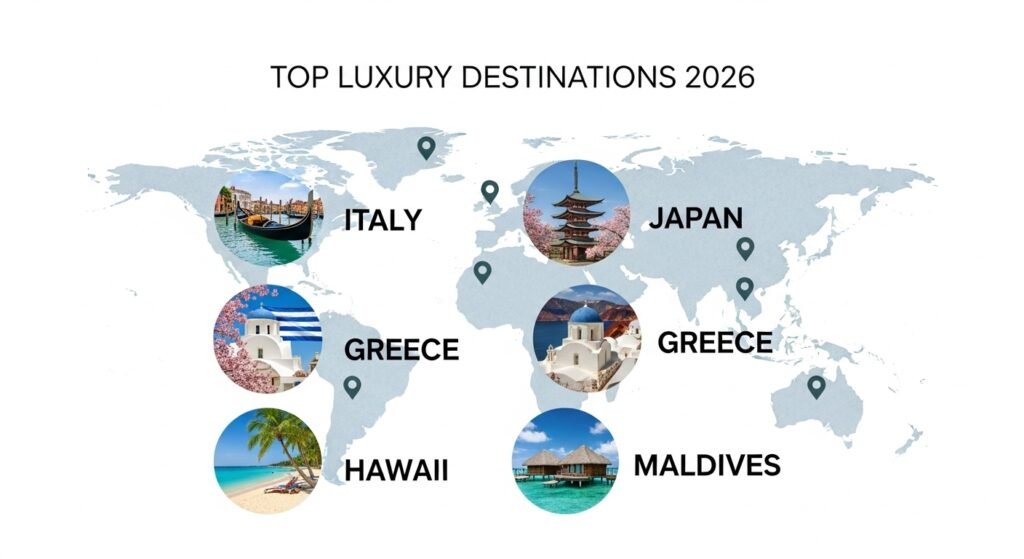
Top advisor-recommended destinations for 2026: Italy, Greece, Japan, Portugal, and Croatia internationally; Hawaii, the Florida Keys, and Napa Valley domestically.
Should you use a travel advisor or book it yourself?
Look — if you’re booking a single resort stay for 5 nights, you probably don’t need a full-service luxury advisor. You need a sharp eye for reviews, a good hotel booking platform, and a direct call to the hotel’s concierge. That’s it.
But if your trip involves more than two countries, a mix of private guides and transfers, a safari or expedition element, or any kind of once-in-a-lifetime milestone framing — the math changes fast. Luxury advisors don’t just save time. They access inventory and upgrade paths that don’t show up in public booking channels.
I’ve seen conflicting data on advisor usage — some sources frame it as declining among younger travelers (who use AI tools), others show it rebounding sharply at the ultra-luxury tier. My read is that the decline is at the mid-luxury level, while bespoke and high-spend travel is seeing an advisor resurgence. Virtuoso’s 2026 Luxe Report, sourced from 2,485 advisors across 50+ countries, supports this split.
Quick comparison
| Option | Best for | Key benefit | Limitation |
| DIY via OTA (Expedia, Booking.com) | Single-destination, hotel-focused trips | Price visibility and flexibility | No exclusive inclusions; limited upgrade access |
| Virtuoso advisor | Multi-destination, milestone, ultra-luxury | Exclusive amenities, insider inventory | Minimum spend thresholds may apply |
| Classic Vacations platform | Beach, resort, and family luxury | Advisor network + packaged luxury value | Stronger for resort-style than urban/expedition travel |
| Boutique concierge agency | Expedition, niche, or ultra-bespoke trips | Deep specialist knowledge per destination | Higher fees; lead times of 6–12 months common |
How to build your luxury itinerary step by step
Anyway, the framework matters more than the destination at this stage. Here’s a practical breakdown:
Start with your “anchor experience” — the one thing that, if it doesn’t happen, the trip was a failure. Build everything else around making that experience as perfect as possible. Transport, accommodation placement, and timing all serve the anchor.
What most guides skip is this: the booking lead time for luxury travel is longer than people expect, and it’s getting longer. Classic Vacations reports that travelers are booking earlier in 2026 to lock in preferred hotels and experiences. For peak-season Italy or Japan, expect 4–6 months minimum for top properties. For safari or Antarctica, 12 months is not unusual.
Arrive early. That’s the most underrated luxury of all.
Blacklane offers premium chauffeur transfers in 500+ airports globally — a straightforward way to ensure the first and last impressions of the trip match everything in between. Small detail. Real impact.
What most luxury travelers get wrong
The most common mistake isn’t over-spending. It’s over-scheduling. Luxury travel has shifted — deliberately — toward slower, more immersive experiences. Virtuoso advisors rank off-peak timing and avoiding overtourism as top concerns for their clients in 2026, with 76% reporting increased interest in shoulder-season travel.
Here’s the thing: a 10-day Italy itinerary with 6 cities is not a luxury trip. It’s a highlight reel. Luxury is two days in Positano doing almost nothing — and remembering every hour of it.
Quick note: sustainability matters more to luxury travelers in 2026 than it did in 2022. 45% of Virtuoso advisors say their clients are actively adjusting plans due to climate change concerns. This isn’t a niche. It’s mainstream at the premium tier, and any luxury travel planner or agency should address it directly.
Quick answers: your top luxury vacation questions
What’s the best time to plan a luxury vacation for 2026?
Now. Top luxury properties in peak destinations are booking 4–6 months out. If you’re targeting summer in Europe or cherry blossom season in Japan, the window is already tight.
How do I find a trustworthy luxury travel advisor?
Start with the Virtuoso network or Classic Vacations. Both operate advisor-led models with vetted specialists by destination. Avoid advisors who can’t name specific properties by experience, not just brand.
Should I use AI tools to plan a luxury trip?
For inspiration and itinerary structuring — yes. For accessing the best inventory, securing exclusive inclusions, or navigating high-stakes milestone travel — pair AI research with a human advisor.
Why does luxury travel cost so much more than premium travel?
You’re paying for two things: access (experiences and properties not available through standard channels) and certainty (the trip will work, every detail has been checked). That’s distinct from simply “better quality” rooms.
When should I consider a luxury all-inclusive over a custom itinerary?
When you want the decision-light experience from day one. Luxury all-inclusives have moved far beyond the budget-resort model — they now offer curated excursions, premium dining, and genuine seclusion at a fixed cost.