This guide covers Oncepik as a productivity and content creation platform for freelancers, creators, and small teams. It does NOT address enterprise-scale deployment or deep API integrations — those deserve a separate breakdown.
What Is Oncepik?
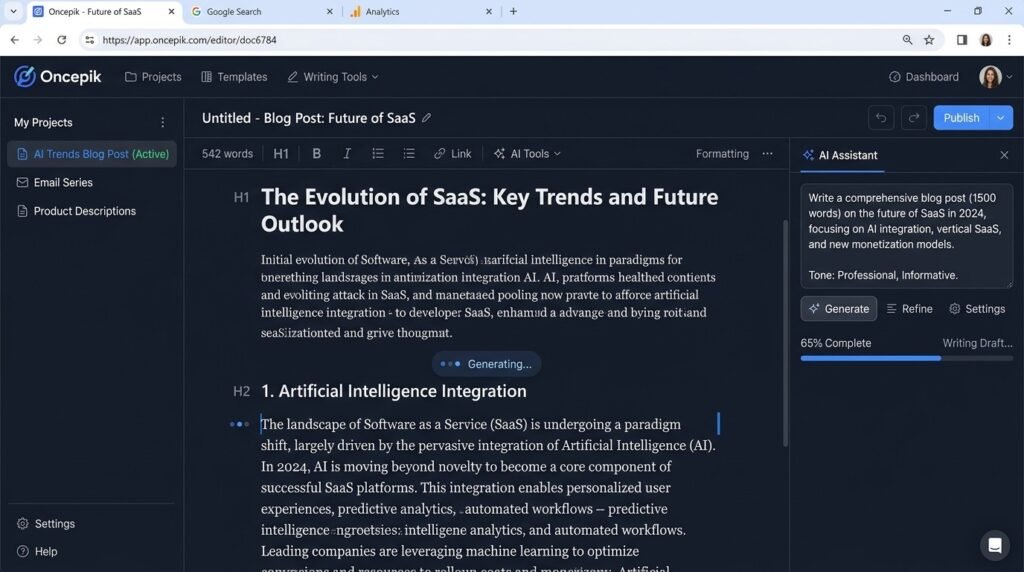
Oncepik is an AI-powered visual workspace that combines content planning, writing assistance, task management, and team collaboration into a single platform. Think of it as a focused alternative to running Notion, a writing AI, and a content calendar simultaneously — without the tab-switching.
That’s the pitch, anyway. Whether it actually delivers depends on your workflow type.
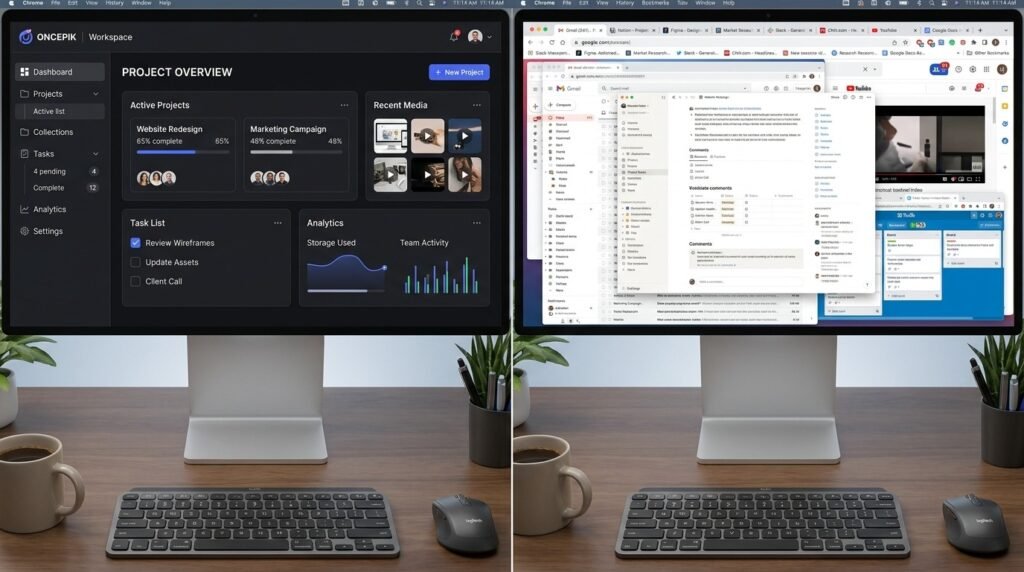
According to McKinsey Global Institute (2023), effective collaboration tools can improve knowledge worker productivity by 20–25%. Oncepik is explicitly built around that gap — the daily friction between ideating, drafting, designing, and coordinating that quietly eats hours.
The platform targets bloggers, freelancers, solopreneurs, and small marketing teams who publish regularly but spend too much time managing software instead of creating content.
What Oncepik Actually Does: Features That Matter
Here’s the thing: most reviews list Oncepik’s features like a spec sheet. That’s not useful. What matters is which features solve real problems and which ones just look good in a demo.
AI Outline and Draft Generation
Feed Oncepik a keyword or topic, and it generates structured outlines with audience-aware angles — not just generic bullet points. Users who’ve tested it consistently report that the AI picks up on previously fed content styles, so output doesn’t feel copy-pasted from a template. That’s a meaningful difference from raw ChatGPT prompting.
Visual Project Boards
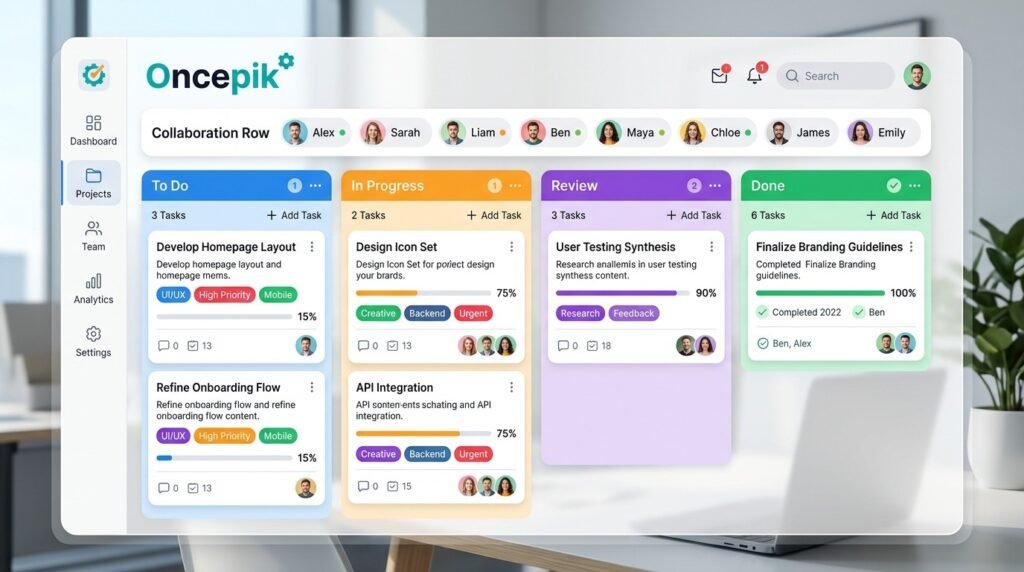
Rather than linear to-do lists, Oncepik uses drag-and-drop boards to organize campaigns, content calendars, and project stages. Creative teams can attach files, notes, and media directly to cards — keeping all project assets in one place instead of spread across Google Drive folders.
One contraction cluster worth noting: it’s clean, it’s fast, and it doesn’t require you to build your own system from scratch — which is exactly what kills Notion adoption for most people.
Multi-Platform Content Export
Write a blog post. Oncepik can repurpose it into social snippets, email subject lines, or video script outlines. The export workflow is smoother than manually reformatting content for each channel.
Real-Time Collaboration
Team members can comment, assign tasks, and edit within the same workspace. No switching to Slack to explain what you meant, then back to Docs to update it.
Quick note: the collaboration features are solid for teams under 10. For larger organizations, dedicated tools like Asana still have a structural depth advantage.
[INTERNAL LINK: productivity tools for freelancers → “Best Tools for Solo Content Creators in 2026”]
Oncepik Pricing: Free, Starter, and Pro — What You Actually Get
This is where most competitor articles go quiet. Here’s what the tiered structure looks like based on current platform data:
| Plan | Best For | Key Benefit | Limitation |
| Free | Solo users exploring | Core features, basic boards | Limited monthly creations |
| Starter | Freelancers publishing 3–5x/week | More content outputs, templates | No advanced automation |
| Pro | Small teams, client work | Faster generation, extra storage, integrations | Still needs Canva for heavy graphic design |
| Enterprise | Growing teams | Custom support, team management | Overkill for solo creators |
Most users land on Starter or Pro. The free tier is genuinely functional for getting a feel for the platform — unlike many SaaS tools where the free plan is barely usable.
Or maybe I should say it this way: the free plan isn’t crippled, but you’ll hit its ceiling within two weeks of real use.
Oncepik official site → current pricing page for accurate tier details
Oncepik vs. Notion vs. ClickUp vs. Jasper AI
Quick Comparison
| Option | Best For | Key Benefit | Limitation |
| Oncepik | Content creators, small teams | All-in-one writing + planning | Can’t replace Canva for design |
| Notion | Flexible knowledge management | Infinite customization | Requires heavy self-setup |
| ClickUp | Large project management | Deep task hierarchy | Overwhelming for solo creators |
| Jasper AI | Fast AI writing at scale | Raw generation speed | No planning or collaboration layer |
Oncepik vs. Notion: Notion is more flexible for random notes and custom databases. Oncepik is more purpose-built for content workflows — it wins on AI writing and easier multi-platform export. The key difference is that Notion requires you to design your system; Oncepik ships with one already built.
Oncepik vs. ClickUp: ClickUp beats Oncepik for large-scale project management with complex dependencies. Oncepik wins on content-specific templates and visual simplicity. If you’re a solo creator or a team under 8, ClickUp’s depth becomes noise.
Oncepik vs. Jasper AI: Jasper is faster at pure text generation. Oncepik goes beyond writing by adding planning, calendars, and collaboration. Users who’ve run both often keep Jasper for long-form article drafts and use Oncepik for the full campaign workflow around it.
Some experts argue that specialized tools will always outperform all-in-ones at their core function. That’s valid when you’re a power user with a locked-in workflow. But if you’re spending 40 minutes a day just switching between apps and re-syncing context, the math changes fast.
5 Notion Alternatives for Content Teams in 2026
Real Limitations Nobody Talks About
Look — if you’re evaluating Oncepik and every review you’ve read sounds like a press release, here’s what actually comes up in real use.
The learning curve exists. The interface is cleaner than ClickUp, but understanding how boards, workflows, and AI prompts interact takes a few days. New users who dive in without setup guidance often abandon it before they see the value.
Internet-dependent. It’s cloud-based. Weak connectivity means slower syncing and reduced functionality. Not a dealbreaker for most, but worth knowing if you work from variable locations.
The design ceiling is real. Oncepik handles text-heavy content and team editing well. For heavy graphic design — brand assets, social media visuals, detailed infographics — you’ll still want Canva or Figma alongside it.
I’ve seen conflicting takes on this: some creators say Oncepik replaced their Canva subscription entirely, while others maintain both. My read is that if visual design is 30%+ of your content workflow, keep Canva.
Peak load slowdowns. A small but consistent pattern in user reports: the platform can feel sluggish during high-traffic periods. It’s not a daily issue, but it shows up when you need it least.
Who Should Actually Use Oncepik
It fits you well if:
- You publish content at least 3x per week across multiple formats
- You currently use 3+ separate tools for planning, writing, and coordinating
- You work solo or on a team of 2–8 people
- You want AI assistance embedded in your workflow, not bolted on separately
It probably won’t help if:
- Your primary need is complex project management with dependencies and resource allocation — ClickUp or Asana will serve you better
- Your content work is 70%+ visual (design-led campaigns) — Oncepik isn’t a Canva replacement
- You need deep CRM or sales workflow integration — that’s outside its current scope
What most guides skip is the honest use-case boundary. Oncepik is a content creator’s tool with collaboration features — not a full business operating system.
Voice Search Q&A
What’s the best use case for Oncepik?
Oncepik works best for freelancers and small teams who publish content regularly and want to combine AI writing, project planning, and team collaboration in one workspace instead of juggling multiple apps.
How does Oncepik compare to Notion?
Oncepik is more structured for content workflows with built-in AI writing tools. Notion offers more customization but requires you to build your own system. Oncepik is faster to set up for publishing-focused teams.
Should I use Oncepik if I already have Jasper AI?
Yes, they serve different roles. Jasper generates content faster at scale. Oncepik adds planning, collaboration, and calendar features around that writing. Many teams use both together.
Why does Oncepik have a learning curve?
The platform combines AI writing, visual boards, and workflows in one interface. Understanding how these layers connect takes a few days of real use — but most users feel comfortable within a week.
When should I choose ClickUp over Oncepik?
Choose ClickUp when you’re managing complex projects with large teams, task dependencies, and resource allocation needs. Oncepik is better when content creation and publishing — not project infrastructure — is your core workflow.
The counter-intuitive truth about all-in-one platforms: Most people assume consolidating tools adds complexity. The data and user reports around Oncepik suggest the opposite — reducing context-switching actually lowers cognitive load, even if the platform itself has more features than any single tool it replaces.