
This guide covers recreational travel burnout for independent travelers taking 5–14 day trips. It does NOT address work travel fatigue, chronic burnout disorder, or medical causes of post-trip exhaustion.
You spent the money. You took the time off. You planned meticulously.
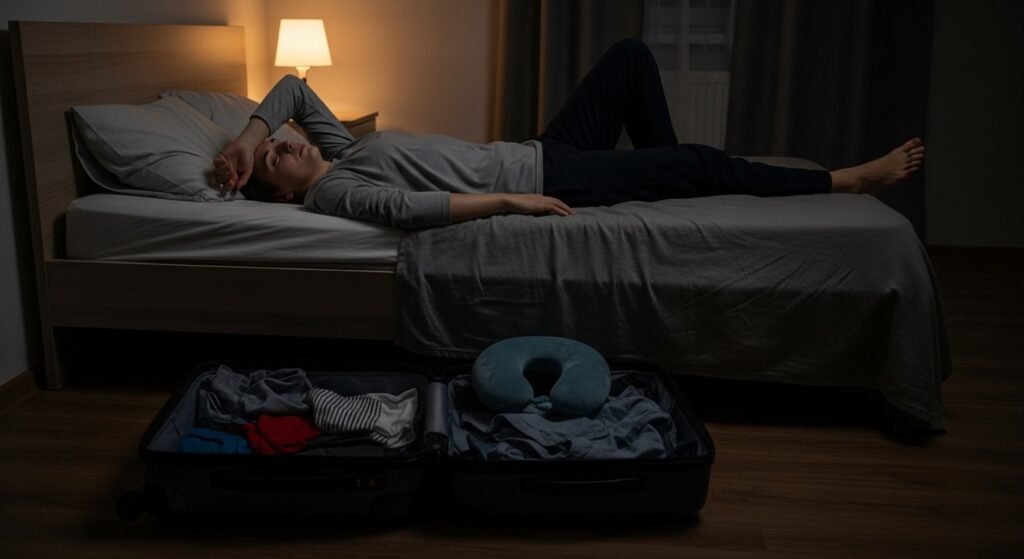
And somehow you’re back home lying in bed on a Sunday night, more wrecked than when you left, dreading tomorrow’s inbox like it’s a second job. The suitcase is still by the door. You haven’t unpacked.
This isn’t a personal failure. It has a name.
“Vacation from vacation“ refers to the phenomenon where travelers return from leisure trips feeling more exhausted, mentally foggy, or emotionally depleted than before they departed — caused by the compounding effects of over-scheduling, sleep disruption, decision fatigue, and the social pressure to perform enjoyment in real time. It’s increasingly common, and it’s entirely preventable.
Why Vacations Are Leaving You More Depleted Than You Arrived
Here’s the thing: the problem usually isn’t the destination.
According to a 2025 analysis published by HomeBusiness Magazine, over 60% of travelers report feeling tired after vacations — not refreshed. The culprit isn’t travel itself. It’s the structure most people unconsciously impose on travel: cram everything in, rest later.
What actually drains you isn’t the flights or the jet lag. It’s the decision fatigue — the relentless stream of micro-choices that pile up when you’re in an unfamiliar place. Where to eat. Which museum first. Is this worth the line? Should we Uber or walk? Every one of those choices costs cognitive energy, and your brain doesn’t know you’re “on vacation.”
Or maybe I should say it this way: your nervous system didn’t get the memo that this was supposed to be rest.
Most people assume that time away from work equals recovery. The data says otherwise. Recovery requires psychological detachment — the mental state of genuinely not thinking about work or performing productivity of any kind. A trip where you’re narrating every meal for Instagram Stories while stress-optimizing your itinerary is not psychological detachment. It’s just stress with better lighting.
The Over-Scheduling Trap (And Why “Making the Most Of It” Backfires)
You’ve seen the itinerary format. Day 1: Arrive, check in, explore the old quarter, sunset viewpoint. Day 2: Museum, food tour, harbor cruise. Day 3: Day trip to the ruins, back by 7 for dinner reservations.
Every day is full. Nothing is wasted.
Except you.
Decision fatigue and over-stimulation are the two most common structural causes of post-vacation burnout — and most travel content actively makes both worse. When every hour is optimized, there’s no buffer for the unexpected, no room for stillness, and no moment where your brain can genuinely idle. That idling is where actual restoration happens.
Look — if you’re someone who books 9 activities across 7 days and comes home feeling hollow, here’s what’s actually happening: your prefrontal cortex is exhausted. The planning, navigating, evaluating, and performing enjoyment all draw from the same limited resource pool as your regular work brain. You didn’t get a break. You just gave it different tasks.
Slow travel advocates have argued for years that fewer activities per day produce more memorable, more restorative trips. That’s valid — and there’s real experiential data to back it. But it’s worth acknowledging the counterargument: some travelers, especially those with limited vacation days, find that structured itineraries reduce the anxiety of “wasting” time abroad. That concern is real. The solution, though, isn’t to cram more in. It’s to change what “wasting time” means to you in the context of travel.
One under-scheduled afternoon in a city will teach you more about that place than six back-to-back museum tours.
Quick Comparison: Packed Itinerary vs. Slow Travel Framework
| Option | Best For | Key Benefit | Limitation |
| Packed itinerary | First-time visitors, short trips (3–4 days) | Maximizes landmark coverage | High decision fatigue, low restoration |
| Slow travel (1–3 activities/day) | 7+ day trips, repeat visitors | Deep experience, genuine rest | Requires comfort with unstructured time |
| Hybrid (2 full days + 1 buffer day per city) | Most travelers | Balance of experience and recovery | Needs deliberate planning discipline |
| Resort/all-inclusive | Relaxation-focused travelers | Low decision load | Can still feel draining without detachment |
The Instagram Effect: How Documenting a Trip Kills the Experience
This one is uncomfortable to say. Documenting your trip — every plate, every view, every “candid” moment — actively undermines the psychological rest your brain needs.
It’s not just about screen time.
When you’re filming and framing and captioning in real time, you’re shifting from experiencer to narrator. The brain’s default mode network — the system responsible for consolidation, memory formation, and genuine rest — gets suppressed. You’re not absorbing the experience. You’re broadcasting it.
Researchers studying tourism behavior have noted this shift in traveler psychology, particularly among millennials: the social media performance of travel has become, for many people, indistinguishable from the travel itself. The trip becomes content. And producing content is work.
Quick note: this isn’t an anti-technology argument. Cameras don’t cause burnout. The compulsion to document everything in real time does.
A useful framework — not a rule, just a starting point — is the 2-hour photo window: one period per day, usually at a key moment like sunrise or a planned excursion, where you intentionally document. Everything else: just be there.
How to Plan a Trip That Actually Restores You
To design a genuinely restorative vacation, apply these principles before you book anything:
To plan a restorative vacation, follow these steps:
- Build one full unscheduled half-day into every 48 hours of your trip
- Choose accommodation that prioritizes quiet and natural light over proximity to attractions
- Set a “no work check” rule for at least the first 4 days — not just a notification limit
- Limit yourself to two planned activities per day maximum
- Schedule a genuine transition day before returning to work — not a travel day, an idle day
Accommodation choices matter more than most guides admit. A noisy Airbnb in the middle of the nightlife district, while exciting, is a sleep disruptor for the entire trip. Sleep disruption is the fastest route to vacation exhaustion. Prioritize natural sleep rhythms — even if that means staying slightly further from the action.
Apps like Calm and Headspace have built dedicated travel and reentry programs worth using, not as gimmicks but as structured tools for the mental transitions that most travelers ignore: arriving, detaching from work, and returning. The Headspace “travel” pack specifically targets the psychological shift of being in an unfamiliar environment. Calm’s sleep series is genuinely useful for the first two nights in a new time zone.
I’ve seen conflicting data on whether pre-trip planning time causes its own anticipatory stress — some studies suggest heavy research and optimization before departure front-loads the anxiety; others show that preparedness reduces in-trip decision fatigue. My read is that the type of planning matters: logistics planning (flights, accommodation, key bookings) reduces fatigue, while activity over-optimization creates it.
How to Recover After a Vacation That Already Exhausted You
You’re already back. It’s already done. Here’s what works.
Don’t try to “re-launch” on the first day back. Most people do the opposite — they tackle the inbox, catch up on messages, and immediately re-enter full productivity mode out of guilt. This compounds the exhaustion instead of resolving it.
Give yourself two low-intensity work days. Not zero-work days — just lower-stakes tasks with no high-decision meetings or creative output expectations if you can manage it. Your brain is still in recovery mode for approximately 48–72 hours after a depleting trip.
For post-vacation burnout recovery, follow these steps:
- Sleep 30–60 minutes longer than usual for the first three nights back
- Avoid social obligations in the first 48 hours — protect the transition window
- Unpack within the first hour of arriving home — the visual chaos of an open suitcase sustains the mental state of “in-between”
- Use a 10-minute Calm or Headspace session each morning for the first week back
- Identify the one structural thing that made this trip exhausting — and plan it differently next time
Travel fatigue recovery isn’t dramatic. It’s mostly protecting sleep, reducing decisions, and giving your nervous system the quiet it didn’t get while you were away.
What Restorative Travel Actually Looks Like
Slow travel isn’t doing nothing. It’s doing less, intentionally.
A restorative trip has a different rhythm than a highlight-reel trip. It might mean spending three full days in one neighborhood instead of hitting four cities. Eating at the same café two mornings in a row because you liked it. Saying no to the optional half-day add-on tour. Reading on a bench for an hour without documenting it.
This is the part most travel content skips — because it doesn’t make good content.
Anyway, here’s the real test: at the end of a trip, do you feel like something happened to you, or do you feel like you were somewhere? One of those is experience. The other is consumption.

Q&A: What Travelers Actually Ask
What’s the best way to recover from vacation exhaustion?
Protect sleep for the first three nights back, avoid social commitments, and unpack immediately. Give yourself two low-stakes work days before any high-decision responsibilities. Recovery typically takes 48–72 hours.
How do I plan a vacation that doesn’t leave me tired?
Limit planned activities to two per day, build in half-day buffers every 48 hours, choose quiet accommodation that protects sleep, and set a firm no-work-check rule for the first four days.
Should I use apps like Calm or Headspace during travel?
Yes — specifically for the transitions. Use them during your first two nights in a new time zone for sleep, and during the re-entry week at home. They’re most useful at the edges of the trip, not mid-adventure.
Why does travel leave me more tired than work does?
Decision fatigue. Travel involves a non-stop stream of unfamiliar micro-decisions that deplete the same cognitive resources as work — without the familiar routines that normally reduce that load. Your brain doesn’t clock out just because you’re abroad.
When should I book a “buffer day” before going back to work?
Always — if you can. A transition day (idle, not travel) between your last vacation day and your first work day dramatically reduces reentry shock and compresses recovery time by roughly half.
1 thought on “Vacation From Your Vacation: Why You’re Exhausted and How to Actually Rest”