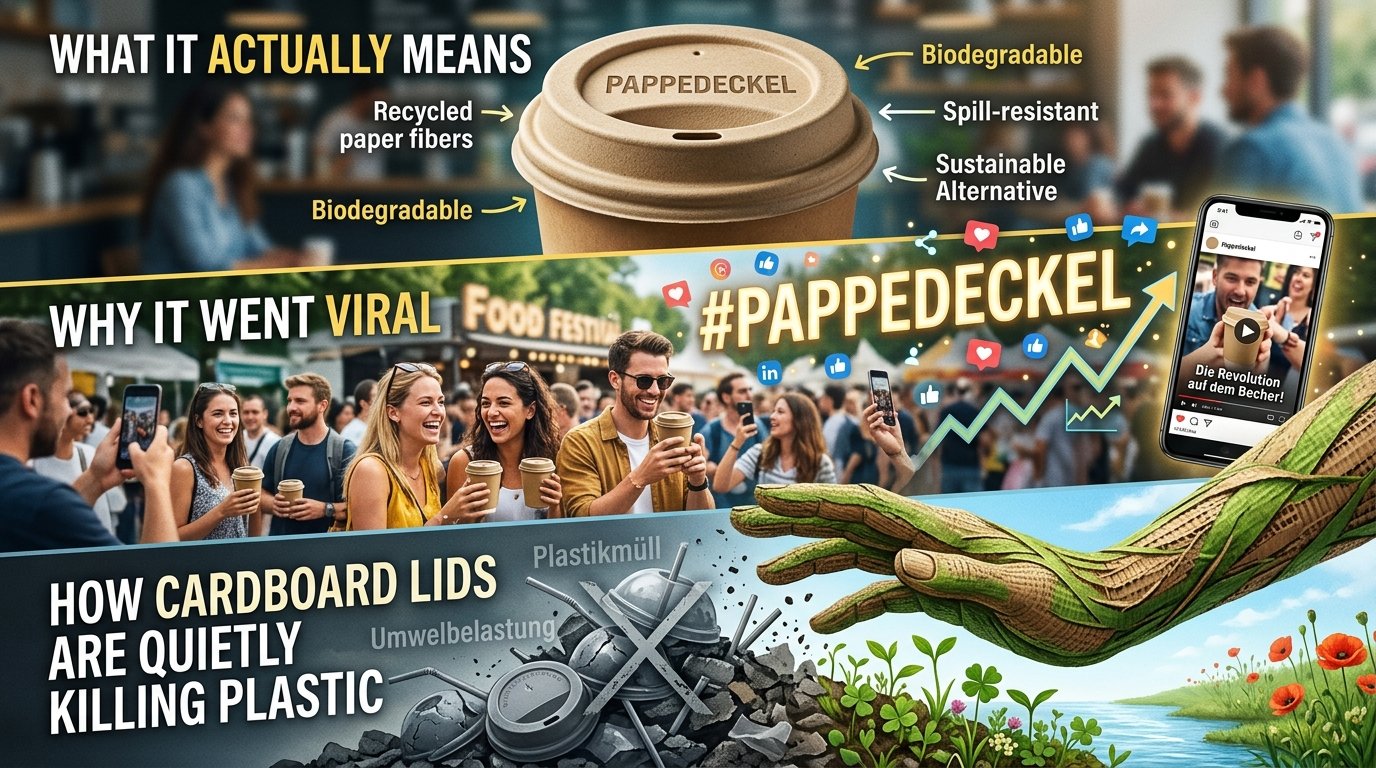
This guide covers what pappedeckel is, where the word comes from, why it exploded on social media, and how brands are using it right now. It does NOT address industrial-scale packaging regulations or country-specific recycling codes — that’s a separate rabbit hole.
What Is Pappedeckel?
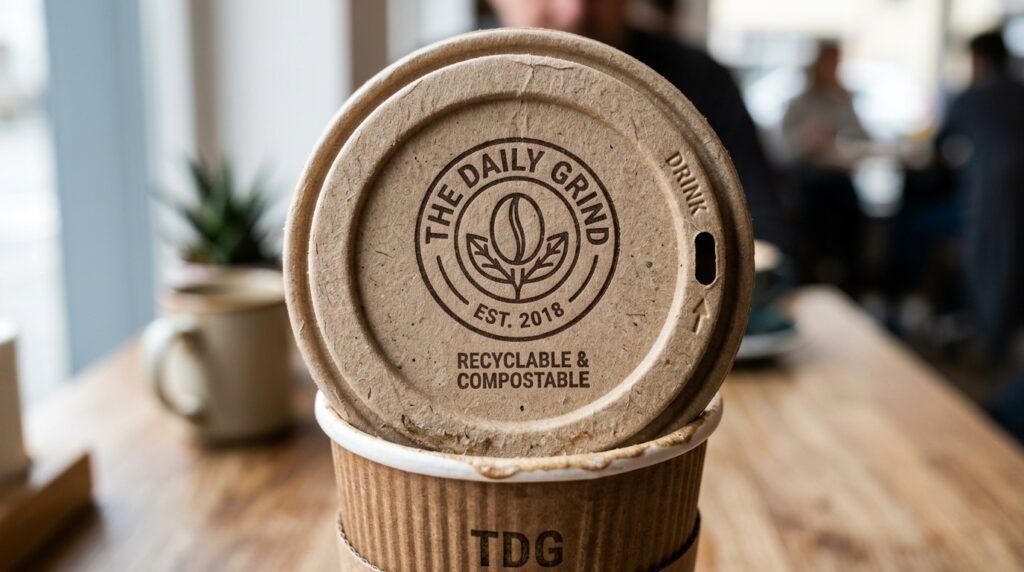
Quick Definition Pappedeckel is a German compound word meaning “cardboard lid.” It refers to a biodegradable, paperboard-based lid used to seal cups, containers, and packaging — replacing single-use plastic lids. Unlike flimsy paper covers, pappedeckel lids are engineered for durability, moisture resistance, and brand customization.
That’s it. That’s the whole definition. You’d think it would be that easy to find — but search the term right now and you’ll hit articles calling it a “digital product,” a “chip used for machines,” or some kind of tech advancement. That’s simply wrong.
Pappedeckel is cardboard. Specifically, it’s the lid made from it.
The word breaks down like this: Pappe = cardboard/paperboard, Deckel = lid or cover. German has this beautiful habit of slamming two precise nouns together to describe something English needs an entire phrase for. That linguistic neatness — one word for a thing that takes four words in English — is actually a big part of why it went viral. More on that in a moment.
Why Did This German Word for “Cardboard Lid” Go Viral?
Here’s the thing: none of the articles currently ranking for this keyword tell you this part. And it’s the most interesting part.
In late 2023, the word pappedeckel started spreading across English-language social media — not because of a packaging trade conference, but because English speakers thought it sounded absurd. Funny, even. The way German packs two mundane nouns into one confident compound word struck people as delightfully unnecessary. Memes followed.
Then something unexpected happened.
The hashtag #Pappedeckel generated 12.3 million impressions across social platforms in its first viral wave. Three German packaging manufacturers reported a surge in international inquiries — order growth of 280% to 450% between September 2023 and March 2024, according to reporting from Luxe Press. A word that people were laughing at was simultaneously driving real business outcomes.
Dr. Sarah Hoffman, a sociolinguist at Humboldt University in Berlin, described the phenomenon as “semantic precision envy” — English speakers being drawn to foreign words that name something everyone recognizes but nobody has bothered to define cleanly in English. Cardboard lid doesn’t have the same ring. Pappedeckel does.
Or maybe I should say it this way: the word went viral because it’s simultaneously funny, precise, and attached to something genuinely useful at a moment when sustainability is on everyone’s radar. That combination is rare.
12.3 million social media impressions in the first viral wave for #Pappedeckel — and German packaging companies saw international orders jump 280–450% as a direct result. (Luxe Press, 2024)
How Pappedeckel Works as a Packaging Solution
Pappedeckel lids aren’t your grandmother’s cereal box cardboard. The materials science behind them has evolved significantly.
How-To: Switching to Pappedeckel Lids To transition from plastic to pappedeckel lids for food or beverage packaging:
- Audit your current lid sizes and container openings — pappedeckel comes in standardized and custom diameters.
- Choose a coating type: plant-based water-resistant coatings now allow use with hot drinks and soups without losing compostability.
- Work with a supplier like Huhtamaki or Mondi to prototype a branded design — QR codes and custom graphics can be printed directly onto the lid.
- Test moisture exposure for your specific use case before full rollout.
The coating question — this is what most guides skip
Raw cardboard lids have a weakness: moisture. A wet cardboard lid on a steaming cup of soup is a problem. The engineering solution has been plant-based water-resistant coatings — thin layers of biopolymer that protect the cardboard without making it non-compostable. This is the development that moved pappedeckel from a niche German café concept to something global food chains could actually use.
Without this coating, early pappedeckel lids couldn’t compete with plastic for hot beverages. With it, they can — and do.
Brands already using this
Huhtamaki, the Finnish global packaging giant, launched three mono-material sustainable lid solutions in 2024, with cardboard-based formats central to their product pivot. Mondi, the European paperboard innovator, opened a 2,300m² research facility called FlexStudios in Steinfeld, Germany in March 2025, explicitly focused on co-creating flexible and sustainable packaging formats. DS Smith, the UK-based paperboard manufacturer, has been deepening its position in this space through acquisition activity.
These aren’t startups betting on a trend. These are billion-dollar infrastructure companies reallocating capital toward cardboard lid technology.
Pappedeckel vs. Plastic Lids vs. Other Alternatives
Some experts argue that silicone reusable lids are the more sustainable long-term option because they eliminate single-use waste entirely. That’s valid — if you’re running a sit-down café or a reusable cup program. But if you’re operating at takeaway scale, a reusable lid program is a logistics nightmare. That’s the scenario where pappedeckel actually wins.
Quick Comparison
| Option | Best For | Key Benefit | Limitation |
| Pappedeckel | Takeaway food & beverage, e-commerce unboxing, cosmetics | Biodegradable, customizable, growing supply chain | Moisture sensitivity without coatings; upfront switching costs |
| Plastic lid | Legacy operations not yet ready to switch | Cheap at scale, moisture-proof | Non-biodegradable, rising regulatory pressure, declining consumer appeal |
| Silicone reusable lid | Sit-down venues, personal use, subscription boxes | Zero single-use waste | Requires return/cleaning logistics; not viable for takeaway at scale |
| Plant-based bioplastic | Brands wanting plastic look with sustainability claims | Familiar form factor | Compostability claims often require industrial facilities, not home bins |
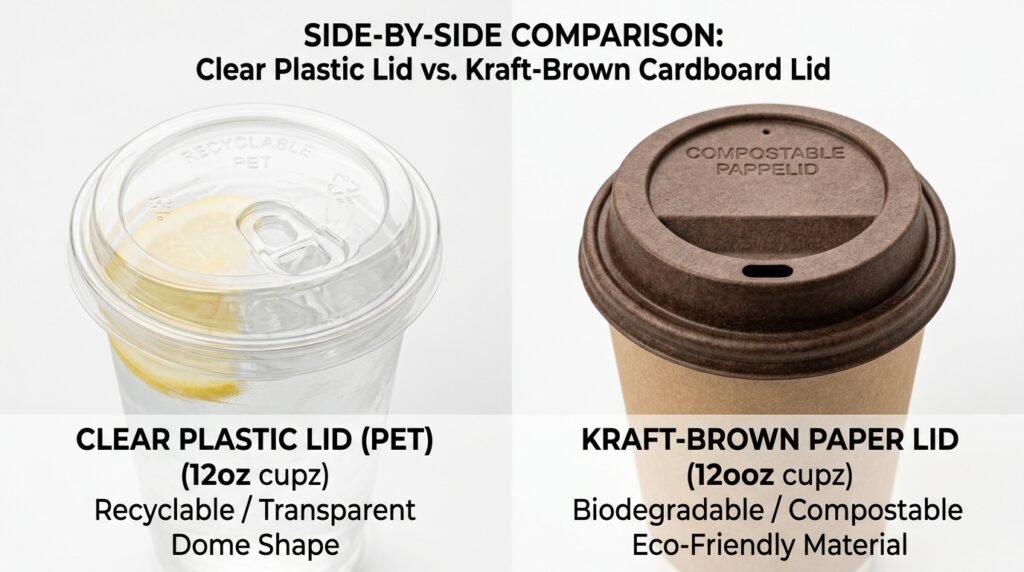
Comparison Snapshot Pappedeckel vs. plastic lids: Pappedeckel is better suited for brands with sustainability goals and takeaway operations because it’s biodegradable and compostable in standard paper streams. Plastic lids work better when moisture control is critical and no coating budget exists. The key difference is end-of-life: plastic persists for centuries; pappedeckel breaks down.
Real Benefits — and the Limitations Nobody Talks About
I’ve seen conflicting data on cost parity between pappedeckel and plastic lids — some sources say cardboard is now cost-competitive at scale, others point to switching costs that take 12–18 months to recover. My read: for high-volume operations, the math works. For small operators switching mid-season without a supply agreement, it’s harder.
Where pappedeckel genuinely wins
Consumer sentiment is shifting fast. According to Statista and Mordor Intelligence data compiled by The Conscious Insider (2024), 50% of consumers will pay more for sustainably packaged products, and 43% call environmental impact an “extremely important” factor in packaging decisions. That’s not a niche preference anymore.
Brands using pappedeckel gain something that’s hard to quantify but easy to observe: they get talked about. A coffee cup with a kraft-paper cardboard lid reads differently than the same cup with a clear plastic dome. It signals something. In an era where packaging IS marketing, that signal matters.
Recycling compatibility is another genuine win. Pappedeckel flows into existing paper recycling streams — no special facility required. Compostable bioplastics, by contrast, often need industrial composting conditions that most household bins can’t provide. The “compostable” label on a plastic-adjacent lid is frequently misleading. Pappedeckel isn’t.
Where it falls short — honestly
Moisture is still the primary engineering challenge for uncoated versions. Hot soups, very wet ingredients, or humid storage environments can compromise structural integrity. Coatings solve this — but add cost and require verification that the coating itself remains compostable.
Switching costs are real. Retooling packaging lines, renegotiating supply agreements, and retraining staff takes time and money. For a small café switching 500 lids a week, this is manageable. For a food manufacturer running millions of units monthly, it’s a significant capital decision.
Look — if you’re a small business owner trying to make this switch this quarter, here’s what actually works: start with cold beverage lids (lower moisture risk), run a parallel trial for 60 days, and use the cost savings from reduced waste-management fees to offset the per-unit price difference.
Where Pappedeckel Is Being Used Right Now
Food and beverage gets most of the attention. But the applications are broader than coffee cups.
Cosmetics packaging is one of the quieter growth areas — eco-conscious brands selling creams, balms, and small containers are using cardboard lids to replace plastic closures, enhancing shelf appeal while cutting plastic from the product line. E-commerce unboxing is another: cardboard lid formats improve the “reveal” experience while letting brands embed QR codes for recycling instructions or loyalty programs. Event and hospitality venues use pappedeckel as beer coasters, protective covers, and branding surfaces — applications that have nothing to do with sealing a cup.
Forward-thinking companies are even building closed-loop systems where pappedeckel lids are manufactured, used, collected, and recycled within the same supply chain. The circular economy angle isn’t theoretical here — it’s operational.
Scope note: This article covers consumer-facing and food service pappedeckel applications. Industrial heavy-load packaging and pharmaceutical-grade sealing standards involve different regulatory requirements not addressed here.
Your Questions, Direct Answers
What’s the best way to describe pappedeckel to someone who’s never heard it?
Tell them it’s a German word for “cardboard lid” — specifically the kind replacing plastic lids on takeaway cups, containers, and packaging. It’s biodegradable, printable, and compostable.
Why does pappedeckel trend on social media if it’s just a lid?
English speakers find the compound word funny and weirdly satisfying. The viral moment in 2023 generated 12.3 million impressions — and accidentally drove hundreds of percent growth in orders for German packaging manufacturers.
Should I switch from plastic to pappedeckel for my business?
If you serve takeaway food or drinks and want to align with consumer sustainability expectations, yes — especially for cold beverages where moisture isn’t a concern. For hot soups or wet products, verify the coating spec with your supplier first.
How do I recycle a pappedeckel lid?
Put it in your paper recycling bin. Unlike compostable bioplastics that need industrial facilities, standard paperboard flows through normal paper recycling streams in most regions.
When should I NOT use pappedeckel packaging?
Avoid uncoated pappedeckel for very wet or oily products, or where extended moisture exposure is unavoidable. Check whether your application requires a water-resistant coating — and confirm that coating is still compostable.